Language of Assessment Matters: New Evidence from Ghana 🇬🇭

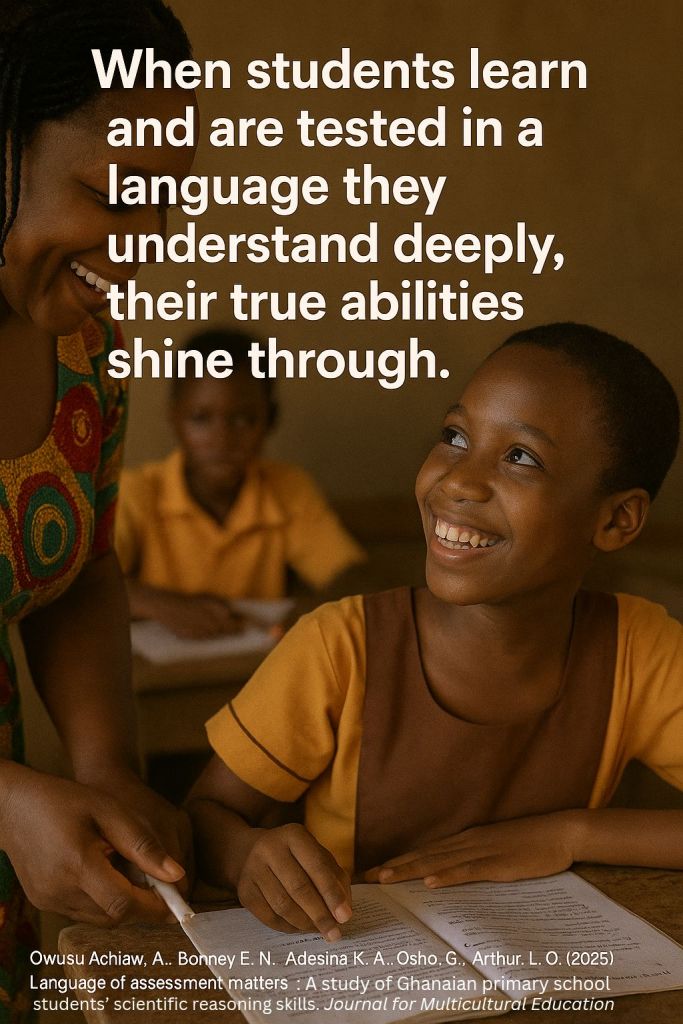
Our recent study, published in the Journal for Multicultural Education, found that primary school students in Ghana performed significantly better in scientific reasoning when tested in Twi – their native language – rather than English.
Key findings:
🧩 Language of assessment was the strongest predictor of reasoning skills.
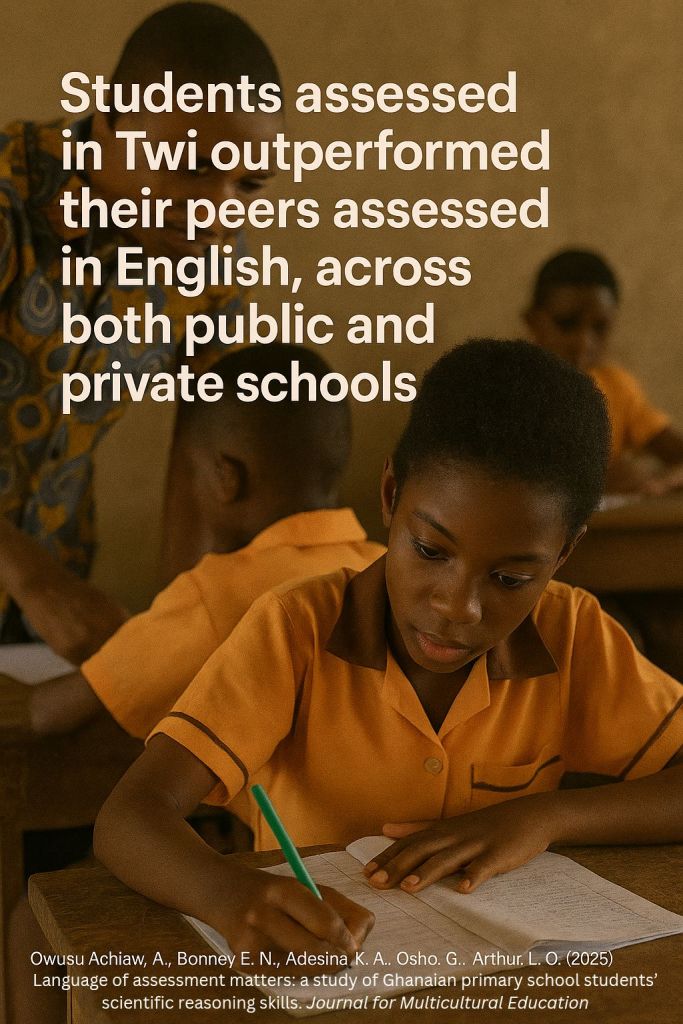
🏫 Students assessed in Twi outperformed their peers assessed in English, across both public and private schools.
👧🏽👦🏾 Gender had no significant effect—showing equitable potential when language barriers are removed.
This research underscores the importance of linguistically responsive and equity-centered assessment practices in multilingual education systems.
We have stuck to teaching and assessing in English for so long that imagining doing it in Ghanaian languages feels impossible and that is limiting the potential of students. We should bravely and creatively reimagine assessment policies that honor students’ linguistic and cultural assets.
I am excited to see Ghana make a shift to using Ghanaian languages as languages of instruction. The hard work begins now to follow through but students will benefit.

Reference
Owusu Achiaw, A., Bonney, E. N., Adesina, K. A., Osho, O., Arthur, G., Osho, L. O. (2025). Language of assessment matters: A study of Ghanaian primary school students’ scientific reasoning skills. Journal for Multicultural Education
New Edited Book
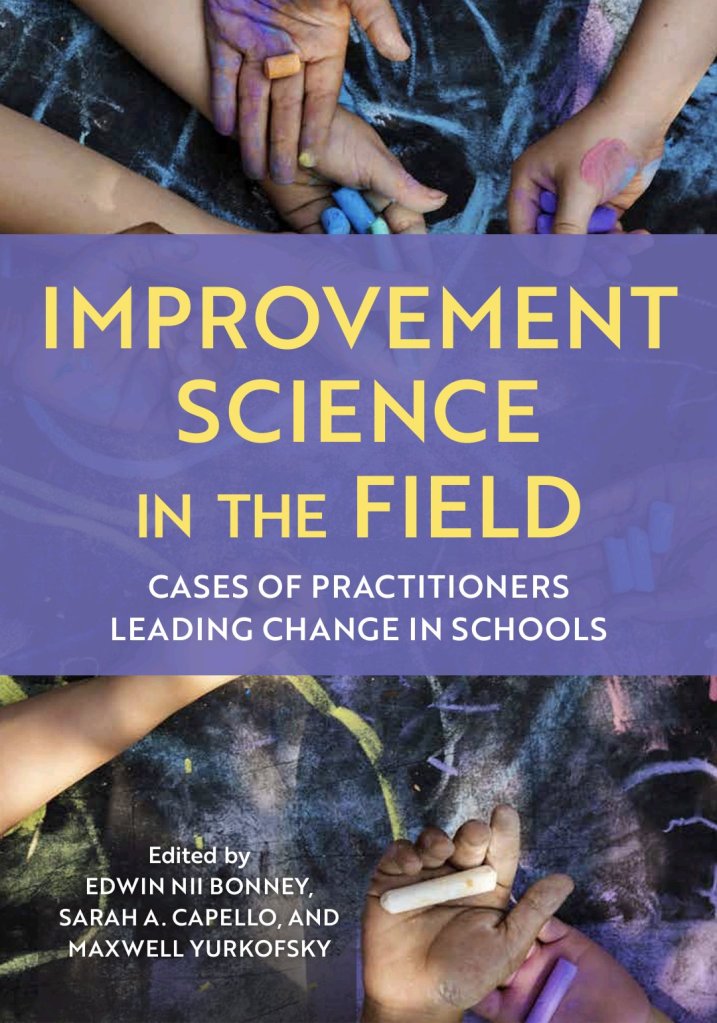
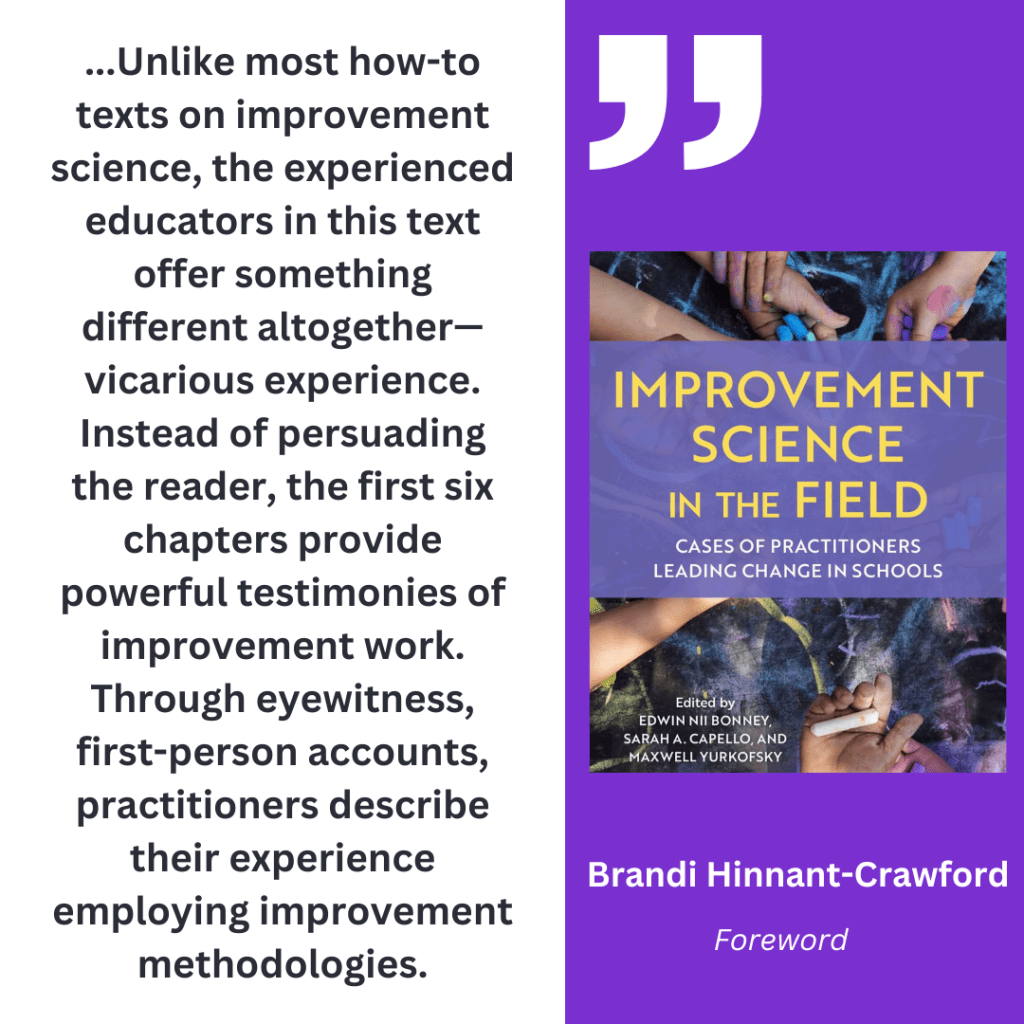
Dr. Sarah Capello, Dr. Maxwell Yurkofsky, and I published an edited book titled, “Improvement Science in the Field: Cases of Practitioners Leading Change in Schools.” This was part of our own journey to find resources to teach and guide practitioners in how to use improvement science in our first years of teaching. This book was written for us, for you, for various key actors and partners in education such as educational practitioners in K–12 schools, students enrolled in graduate degree programs in education, and faculty in higher education institutions involved in preparing current and future educational leaders as a resource for learning and teaching. The book is also for interest and advocacy groups, school boards, and professional learning communities (PLCs) in education that are interested in critically examining problems of practice and collaboratively working together toward finding evidence-based solutions that will improve their schools and communities.
This book was written for us, for you, for various key actors and partners in education
Bonney et al. (2024, p. xv)
Book Reviews
An “improvement movement” is afoot in education, in the United States and around the world. This movement empowers local teachers, leaders, family members, and community advocates to use rigorous approaches to local innovation to address local educational opportunities, needs, and problems. Improvement Science in the Field gives voice to these local change agents, makes their practice visible to others, and provides novel perspectives on the day-to-day work of advancing new ambitions for students’ learning and development. This volume is sure to inspire and guide others who are embracing the challenge of transformative educational change
Donald Peurach, professor, University of Michigan, School of Education
Improvement Science in the Field offers definitive examples of EdD students who have implemented the tools of improvement science to address complex challenges found in their professional practice. Readers of this book will learn in two ways—first, by following the journey of six projects, readers will experience the improvement process alongside and through the eyes of the student investigator. Second, using learning cases readers will engage and grapple with the improvement process through discussions of real-world problems of practice playing out in educational systems.
Jill Alexa Perry, Professor of Practice, University of Pittsburgh & Executive Director, Carnegie Project on the Education Doctorate (CPED)
By amplifying the voices and experiences of educators and illuminating how practitioners sought to solve crucial issues (e.g., racial disparities in student discipline, teacher wellness in the Covid-era), the authors open up the black box of improvement science. For instance, the book makes concrete various steps of PDSA cycles and how to analyze and use data obtained via empathy interviews. Additionally, Improvement Science in the Field embeds tools and suggestions for routines that hold much potential for supporting the efforts–plus learning–of teams of practitioners. Ultimately, the testimonies and insights of this book will improve educational systems and practices
Sarah Woulfin, professor of education, University of Texas at Austin
Answering a call for strong examples of improvement and filling a gap in the improvement science literature, this book’s stories and cases help those who teach, lead, and implement improvement science uncover how teams identify, understand, and address equity-focused problems of practice. These stories also help the field gain confidence in improvement science as a lever for change in schools, giving the reader access to proven change ideas and advice on how to navigate leading change in our complex school systems.
Erin Anderson, associate professor of educational leadership and policy studies, at the University of Denver
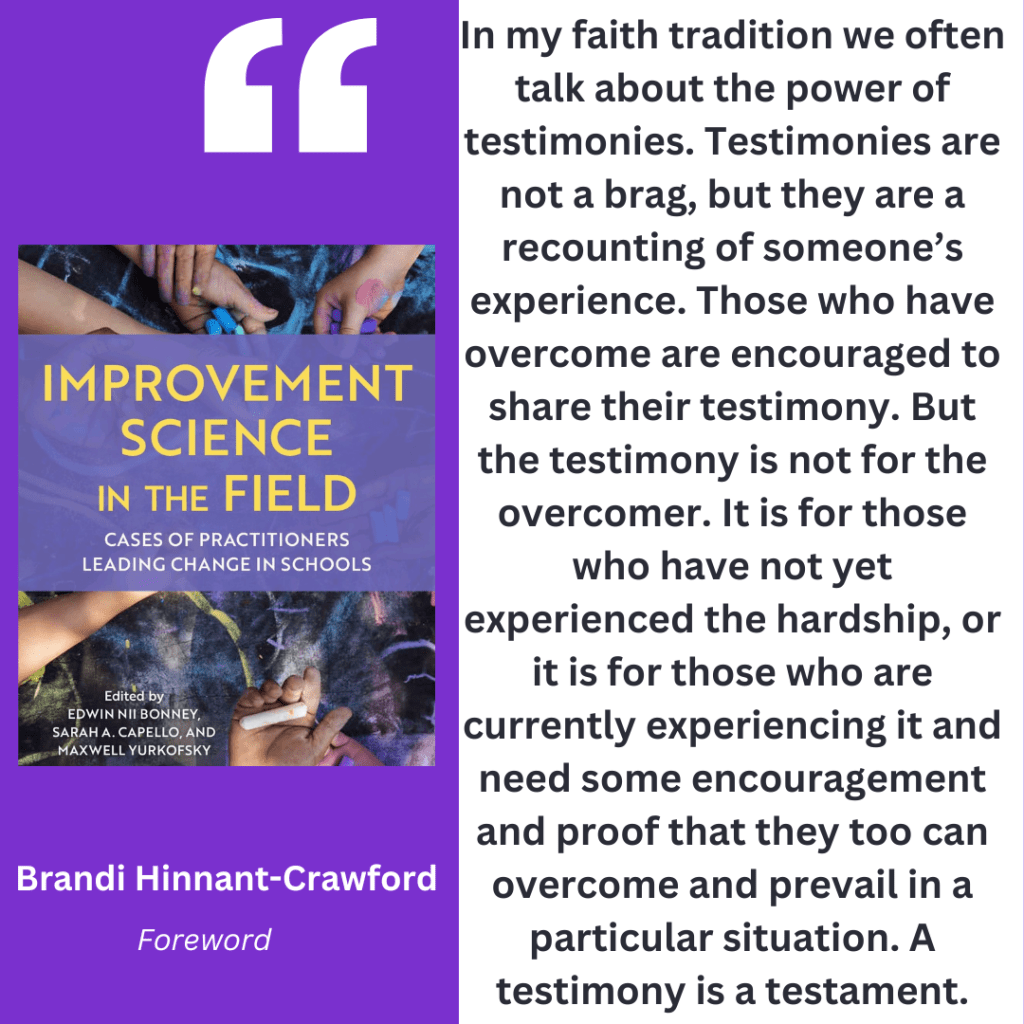
SPECIAL OFFER
25% DISCOUNT OFF LIST PRICE USING CODE RLFANDF25 when you purchase from rowman.com
(This is not for Resellers or Institutional Bulk Orders)
Hardback, 978-1-5381-8016-7, list price $95.00/£73.00 after discount $71.25/ £54.75
Paperback, 978-1-5381-8017-4, list price $35.00/£30.00, after discount $26.25/£22.25
Ebook, 978-1-5381-8018-1, list price $33.00/£25.00, after discount $24.75/ £18.75
Dad, how do you say dimples in Gā?
During the pandemic my son, Teddy, and I bought a Gā language dictionary. He had started to ask me random questions about how to say certain English words in my native language -Gā.
His questions reminded me of my time as a Spanish instructor during my master’s degree program where my students used the phrase “¿como se dice…[insert the word you want to know] en Espanol?” If you have ever studied a second language, this phrase is handy in navigating interactions.
Teddy had just turned five and so saying “I don’t know how to say it” was never satisfying to him. We had always taught him that not knowing something, meant it was a chance to learn something new. This time he wanted to know how to say “dimples” in Gā,
Continue reading “Dad, how do you say dimples in Gā?”Decolonization begins with me
I identify as Ga from the Ga ethnic group of Ghana. Throughout my education, I have loved languages and cultures and what they represented and still do. Ghana was a British colony from the 1850s to 1957 and with colonization came a creation, validation, and a reinforcement of English linguistic imperialism in the country which meant that Ghanaian languages and cultures were not perceived as standards of civilization and progress. I was schooled in the aftermath of this system where the pursuit of knowledge in Ghanaian languages and cultures was and is not encouraged but the acquisition of English language proficiency and Anglo/Western standards is applauded and promoted.
Continue reading “Decolonization begins with me” Edwin Nii Bonney