
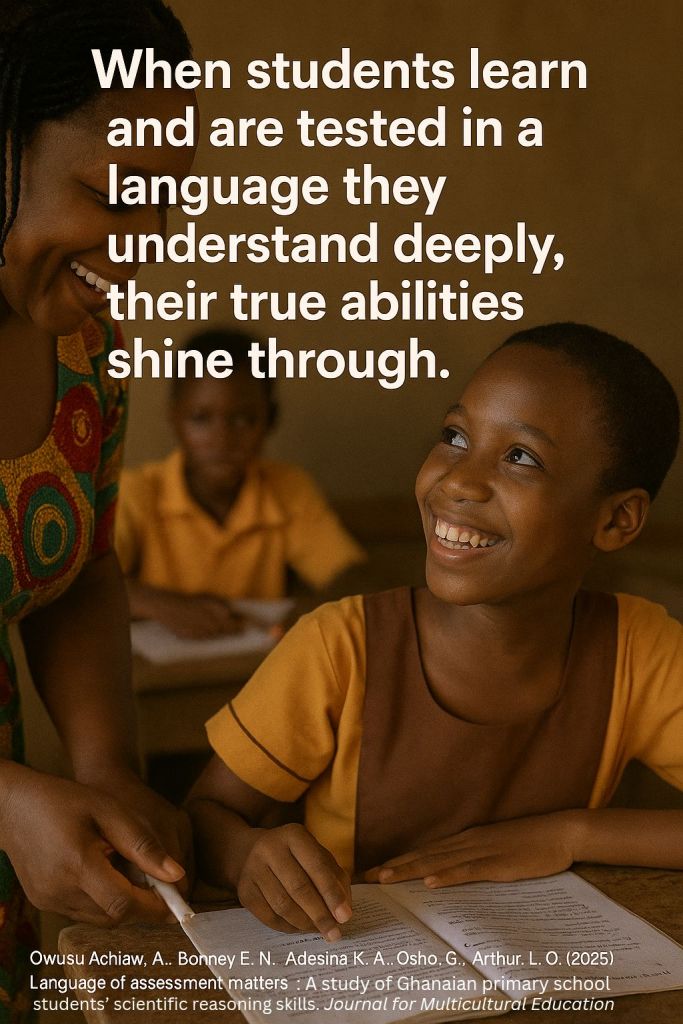
Our recent study, published in the Journal for Multicultural Education, found that primary school students in Ghana performed significantly better in scientific reasoning when tested in Twi – their native language – rather than English.
Key findings:
🧩 Language of assessment was the strongest predictor of reasoning skills.
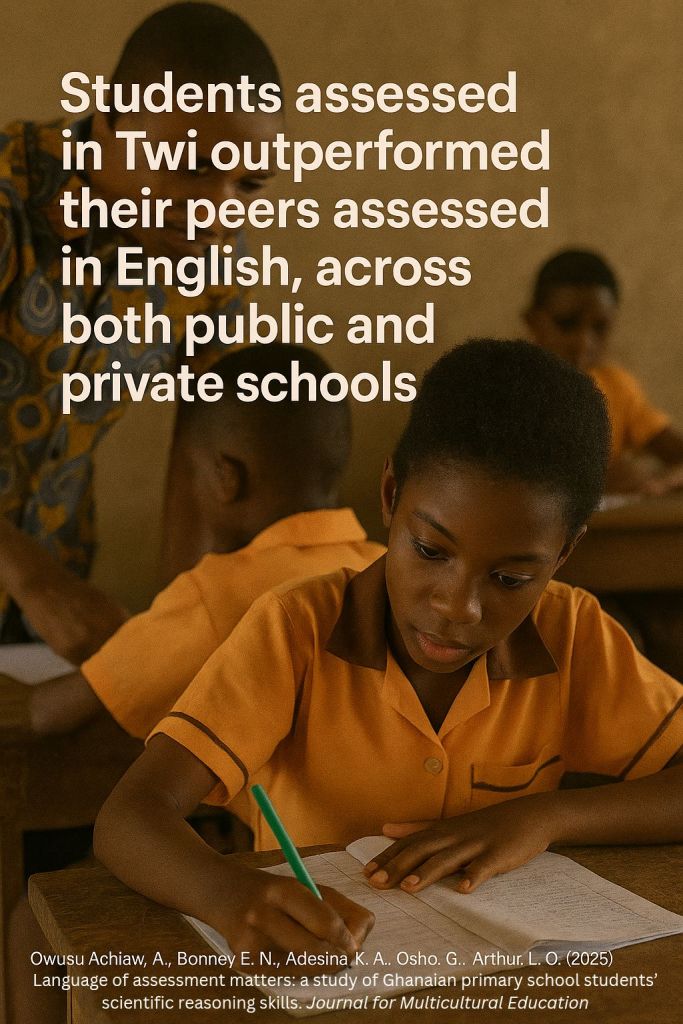
🏫 Students assessed in Twi outperformed their peers assessed in English, across both public and private schools.
👧🏽👦🏾 Gender had no significant effect—showing equitable potential when language barriers are removed.
This research underscores the importance of linguistically responsive and equity-centered assessment practices in multilingual education systems.
We have stuck to teaching and assessing in English for so long that imagining doing it in Ghanaian languages feels impossible and that is limiting the potential of students. We should bravely and creatively reimagine assessment policies that honor students’ linguistic and cultural assets.
I am excited to see Ghana make a shift to using Ghanaian languages as languages of instruction. The hard work begins now to follow through but students will benefit.

Reference
Owusu Achiaw, A., Bonney, E. N., Adesina, K. A., Osho, O., Arthur, G., Osho, L. O. (2025). Language of assessment matters: A study of Ghanaian primary school students’ scientific reasoning skills. Journal for Multicultural Education
 Edwin Nii Bonney